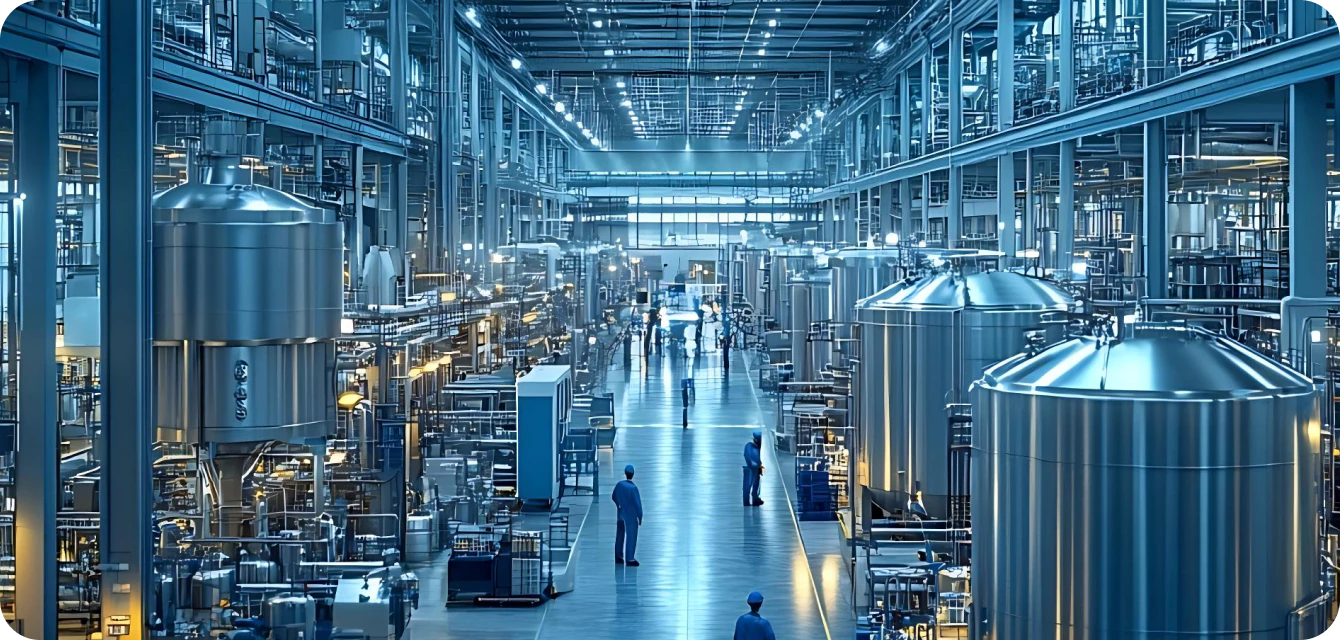
Key production points, including reaction vessels and transfer pipes
Data updates
The case describes updates every 10 seconds, transmitted to the production control system
The challenge
Blind Spot in Real-Time Monitoring of Key Concentrations
In sodium hypochlorite and sodium hydroxide production, there is a lack of real-time monitoring for effective chlorine and free alkali concentrations, resulting in insufficient production data support.
Read background
Abnormal free alkali concentrations can affect the stability of subsequent reactions, while the effective chlorine concentration in sodium hypochlorite and the free alkali concentration in sodium hydroxide directly determine raw material quality. For instance, low effective chlorine levels can reduce the disinfection efficacy of sodium hypochlorite. However, traditional production methods lack real-time monitoring, relying on periodic sampling and data recording, which fails to capture sudden concentration fluctuations.
Delayed Regulation Disrupts Production Rhythm
Manual testing or delayed monitoring impacts the efficiency of production plan execution.
Read background
Most companies rely on manual periodic testing, typically conducted once every two hours, with the process from sampling to results taking over 30 minutes. If test results indicate excessive concentrations, production adjustment instructions reach the workshop nearly an hour later, disrupting the planned batch production schedule.
Safety Risks from Manual Sampling
Production involving chemical substances poses safety hazards during manual operations.
Read background
Sodium hypochlorite is corrosive, and sodium hydroxide is a strong alkali. Manual sampling requires contact with raw material solutions, and improper protective gear can lead to liquid splashes and burns. For example, a factory reported an incident where a worker's glove was damaged during sampling, resulting in sodium hydroxide solution contacting the skin and causing burns, which impacted both worker health and production efficiency.
How it works
Pressure-Resistant Integration for High-Risk Production Lines
The Online Liquid Spectral Analyzer (Pressure-Resistant Version) is designed for sodium hypochlorite and sodium hydroxide raw material production scenarios. Its pressure-resistant design meets the safety standards of chemical production workshops and can be directly installed at critical nodes such as reaction vessels or pipelines without requiring extensive modifications to existing equipment, adapting to production lines of varying capacities.
Dual-Parameter Seconds-Level Tracking of Dynamic Fluctuations
Real-time monitoring of effective chlorine in sodium hypochlorite and free alkali in sodium hydroxide, with sensors continuously collecting data and updating results every 10 seconds. Data is synchronously transmitted to the production control system, allowing workshop managers to view real-time concentration curves on monitoring screens.
What changed
Data-Driven Precision in Production Planning
Provides real-time data support to enhance the efficiency of executing production plans. Real-time concentration data enables timely adjustments; for instance, when a drop in effective chlorine concentration is detected, the system can automatically prompt raw material additions, avoiding delays that impact progress. After implementation, there is a case that a company's production plan completion rate increased from 75% to 95%.
Human-Machine Isolation for Zero-Contact Safety
Reduces manual involvement in monitoring, significantly improving worker safety. The monitoring process eliminates the need for manual sampling or testing, minimizing worker exposure to chemical raw materials by over 90%. In the past year, no chemical burn incidents have been reported among companies using this solution.
Stable Concentration Control for Loss Reduction and Efficiency Gains
Enables precise control of raw material concentrations, ensuring production stability. Real-time monitoring allows timely adjustments to raw material ratios, reducing the fluctuation range of effective chlorine and free alkali concentrations from ±0.5% to ±0.1%. The rate of non-compliant products dropped by 60%, with fewer production stoppages for adjustments and reduced energy consumption.
Reported results describe this project and its operating conditions. Suitability for your application requires evaluation of your sample and installation.
Let's talk about your application
What would you like to measure?
You don't need a finished specification. Tell us about your sample and the problem you want to solve.
The material or sample you work with
The measurement you need
Where you plan to use it
Prefer to contact us directly?
bd@vispek.cn
International sales
+86 187 8028 5542
China sales
+86 186 6590 3209
Office
+86 755 2665 1125
Office address
Room 501, Building K, North Zone, Qianhai Shenzhen-Hong Kong Youth Innovation Hub, 5188 Menghai Avenue, Shenzhen, China