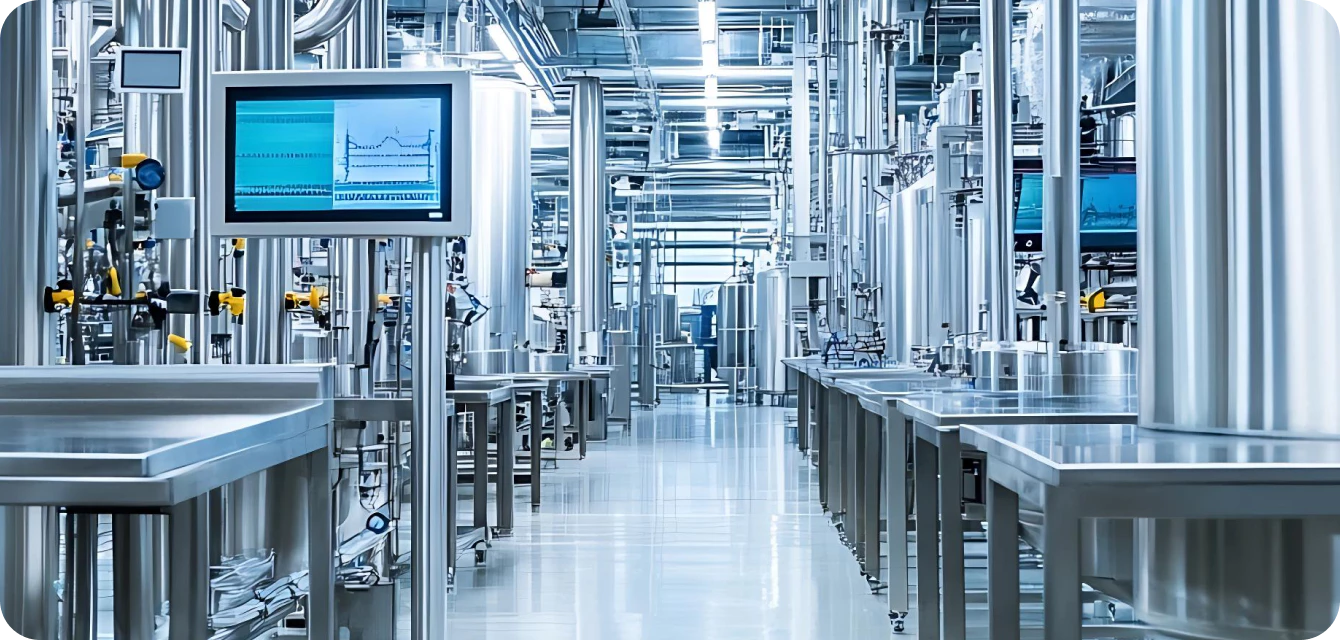
The case describes data generated every 30 seconds and sent to the monitoring platform
The challenge
Delayed Detection Weakens Antifreeze Protection
Manual sampling and lab testing are slow, preventing real-time tracking of ethylene glycol concentration.
Read background
Cooling systems must maintain 30–40% concentration (too low reduces antifreeze capability, too high affects heat transfer). Traditionally, samples are taken every 4 hours and lab results return in 1 hour, meaning the system runs for nearly 5 hours without updates. One chemical plant missed a drop to 25%, causing localized pipe freezing and reduced heat exchange efficiency.
Severe Frostbite Risk in Manual Sampling
Manual sampling exposes operators to extreme cold, with coolant temperatures typically between –10°C and –5°C.
Read background
Opening pipeline valves can cause liquid splashes, and tools frost over upon contact, risking skin injury. One factory recorded three frostbite incidents in a year, including one case requiring a week of medical leave.
Delayed data cannot support timely refrigeration adjustment, risking production instability.
Read background
Some reactions require strict temperature control (e.g., 20°C ±1°C for a polymerization process). If glycol concentration fluctuations affect cooling, delayed adjustments can cause temperature swings. One plant saw temperatures fluctuate between 17°C–23°C, leading to off-spec polymer molecular weight distribution and a 15% drop in yield.
How it works
Armored Integration for –30°C Extreme Environments
The Online Liquid/Solid Spectral Analyzer is used for quantitative monitoring of ethylene glycol concentration in circulating coolants. Designed for low-temperature, high-pressure environments, it can be directly mounted on the main coolant pipeline, operating reliably from –30°C to 50°C, suitable for sealed cooling systems in chemical and pharmaceutical industries.
Concentration updates every 30 seconds
Replaces manual sampling and lab testing with online, real-time measurement. The built-in concentration sensor contacts the coolant directly, generating readings every 30 seconds and transmitting them to the production monitoring platform, displaying live values and trend curves without manual intervention.
Addresses delayed data and sampling safety risks with a robust monitoring mechanism. The system triggers audio-visual alarms when glycol concentration falls below 30% or rises above 40%. It also links to the refrigeration control system, prompting early "Prepare to adjust cooling power" alerts when abnormal concentrations affect cooling performance, preventing delays caused by manual judgment.
What changed
Lower sampling costs
The previous process required two operators working in shifts, about CNY 200 per day in sampling consumables, and a testing cycle of up to 5 hours. The source case reports that online monitoring removed the need for dedicated sampling staff and reduced consumable costs to less than CNY 300 per month. Reported annual savings exceeded CNY 80,000 at one plant.
Reduced manual contact with cold coolant
Operators no longer needed to collect low-temperature coolant samples by hand. The source case records no further frostbite incidents at the adopting company during the year described. Employees’ perceived operational-safety score rose from 65 to 92 out of 100.
More stable cooling in the reported installation
Operators used online readings to adjust refrigeration settings. The source case reports a reduction in cooling-temperature variation from ±3°C to ±0.5°C and an increase in the pass rate of one polymerization product from 82% to 98%. It also reports a 12% reduction in monthly electricity costs after cooling power was adjusted to demand.
Reported results describe this project and its operating conditions. Suitability for your application requires evaluation of your sample and installation.
Let's talk about your application
What would you like to measure?
You don't need a finished specification. Tell us about your sample and the problem you want to solve.
The material or sample you work with
The measurement you need
Where you plan to use it
Prefer to contact us directly?
bd@vispek.cn
International sales
+86 187 8028 5542
China sales
+86 186 6590 3209
Office
+86 755 2665 1125
Office address
Room 501, Building K, North Zone, Qianhai Shenzhen-Hong Kong Youth Innovation Hub, 5188 Menghai Avenue, Shenzhen, China